1. Introduction
Objectives
During the IP-1 project you and your team are going to create an electronic system that can play back audio from the headphone port of a PC or a phone on a big speaker box. Figure 1 shows the simplified signal path, which goes through the following steps:
The audio source, a PC or a phone, plays an audio file that is stored on the device in binary. The file is decoded and converted into a voltage signal that is applied on the headphone output port of the device.
The jack cable connects the signal input of the audio system to the headphone port, thus applying the headphone voltage to the input of the audio system.
The audio system ensures that the sound heard by the ear accurately reflects the voltage signal coming from the headphone port. This will be explained in more detail in later in this chapter.
The speaker box converts voltage signals into sound pressure signals. The box has 4 speakers of 3 types: a tweeter, a midtoner, and two woofers connected in parallel. Each type can only play sound within a limited frequency range. When playing sound outside that range the speaker may be quiet or it may even break. The speaker box is modeled as 3 individual speakers in the remainder of this section and in most of the rest of this manual.
The air transports sound pressure waves from the speaker box to the listener’s ear.
The ear converts the local sound pressure into nerve signals that we perceive as sound.
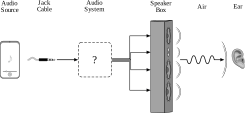
Figure 1:Simplified diagram of the signal path from source to ear.
The audio system prevents two problems that would occur if the headphone output were connected directly to the speaker box. Firstly, headphone outputs cannot supply the voltage and current needed to drive the speakers, so the sound would be very quiet - if audible at all. Secondly, the audio system must ensure that all speakers together will produce a balanced sound, without certain frequency ranges sounding more pronounced or weaker than others. If that would happen, the sound pressure at the ear would not accurately reflect the voltage signal from the source.
To solve these problems the signal power must be amplified, and the signal must somehow be split in partial signals to send to each speaker such that the sound pressure at the ear is close to proportional to the source voltage. It is significantly easier to make these modifications to the signal in the electrical domain than in the mechanical or in the acoustic domain. Hence, an electronic circuit, the audio system, is inserted between the source and the speaker.
In short, the project objective is to create an electronic audio system that meets the following objectives.
Objective 1: Amplify the power of the audio signal.
Objective 2: Cause the sound pressure at the listener’s ear to be approximately proportional the the headphone port voltage.
Objective 3: Prevent the speakers from playing frequencies outside of their designed range.
Design
Circuit design can be incredibly complex. Typically the stricter a circuit’s requirements the more complex the circuit tends to become. Because the IP-1 project runs for only 8 weeks, the circuit should be simple enough that a team can finish it within that time. To this end, we introduce a few techniques to reduce the circuit’s complexity:
Scope: Clearly define what part of the problem context is part of the project (i.e. inside the scope) and what isn’t (i.e. outside the scope). If something is outside the scope of the project, it does not influence the success of the project. The less there is to take into account, the more the project complexity is reduced.
Approximations: If the model of a part of the system is complex, it can be approximated. This reduces the model’s complexity at the cost of also reducing its accuracy.
Assumptions: If a question has many unknowns or if it would take long to answer, one can make an educated assumption of what the answer could be. This reduces the complexity of answering the question at the cost of also reducing the accuracy or completeness of the answer.
Scope
Objective 2 requires the audio system to compensate for influences that cause the shape of the sound pressure that is observed by the listener to differ from the shape of the headphone port voltage. Instead of making a lengthy overview of all influences, the most important influences that can be considered outside the scope of the project are listed here.
Every ear hears sound slightly differently. Because the variable properties of ears are outside our control, tests of the audio system are performed with a microphone that acts as a universal ear. This microphone should always point at the speaker from a the same relative position and angle to make measurements comparable.
Every room has different acoustic properties. Changing the geometry of a room or the material of an object in it changes how pressure waves are reflected, refracted and absorbed. Additionally, other sources of sound may be present in a room. Because these effects are highly complex and largely outside of our control, they are ignored. However, when performing measurements one should make sure that the path between the speakers and the observer is unobstructed, and that other sources of sound or reflections have a relatively negligible effect on acoustic measurement results.
The listener is at a different distance from each speaker, which means the sound delay from each speaker is different. By placing the listener far enough away from the speaker, this effect can be considered negligible and can thus be considered outside the scope.
When the sound becomes too loud, a speaker may become unable to handle it. This manifests as a nonlinear relation between its input voltage and output pressure. When the volume is inceased further, the speaker may even break. Because nonlinear effects greatly complicate our analysis, we limit ourselves to volume ranges where nonlinear effects not dominant.
The speaker box given to you may not be modified. The reasons as to why are left as an exercise to the reader.
Objective 1 requires the audio system to draw power from an external power source. Instead of making this source ourselves, the power can be drawn from the 230 Vrms power grid.
Approximations and Assumptions
The behavior of each speaker is rather complex. To simplify the analysis, to save time not having to research complex topics, and to prevent the audio system from becoming more complex than you are expected to handle at this stage of your studies, the following assumptions are made.
Assume the input voltage of each speaker is approximately proportional to its output pressure.
Assume the voltage-to-pressure transfer of each speaker is approximately linear.
Assume the voltage-to-pressure transfer of each speaker is approximately flat in the passband (the range of frequencies that this speaker is engineered for).
Assume the vibration of one speaker does not affect that of another.
Assume the input impedance of the speaker is approximately linear.
Additionally, it can be assumed that the differences between the headphone port voltages generated by different modern sound sources, such as smartphones and PCs, are negligible. Their maximum amplitude may vary slightly, but their shapes can safely be assumed to be identical.
Derivation of Subsystems
The scope and assumptions listed above limit the part of the signal path from Figure 1 that you have control over to only the audio system.
Clarification of Objective 2
Before effective solutions to the design problem can be proposed, Objective 2 needs to be clarified further. To compensate for influences that change the observed pressure signal compared to the original voltage signal, the nature of these influences needs to be understood. Within the defined scope only the influence of the linear behavior of the speakers, and how their sound adds up, remains.
Approximating the behavior of each speaker using the listed assumptions, their influence on the signal transfer can be modeled as follows. Imagine 3 speakers of different types that are driven by the same voltage signal. Figure 2 shows the frequency transfer of each individual speaker in this hypothetical scenario. When the contribution of each speaker is added up, the overall signal transfer may look like the solid blue line. Notice that certain frequencies are made louder than others.
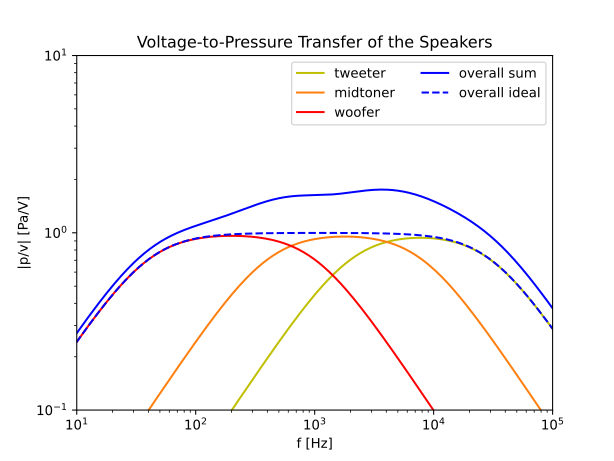
Figure 2:Example of how the overlap between the frequency ranges of speakers causes the volume of certain frequencies in the overall transfer to be louder than other frequencies. Note that the axes are inaccurate, and that this image is a strong oversimplification of reality.
The flatter the blue graph in Figure 2 looks, the more closely the audio output resembles the voltage input. In jargon we call this a flat transfer. Note that this transfer only needs to be flat between approximately 20 Hz and 20 kHz, because the human ear cannot hear outside this range.
Functions and Mechanisms
To meet Objective 2, the voltage to pressure transfer from audio system input to speaker box output must be made as flat as possible. Peaks in the overall transfer are caused when the transfers of individual speakers overlap. These overlaps can be eliminated by restricting the signals going into each speaker to more narrow frequency ranges that do not overlap. A circuit that changes the frequency profile of a signal is called a filter.
One mechanism that can be used to create a filter is the fact that the impedance of capacitors and inductors depends on frequency. In the course EE1C2 you learn how this can be used to create simple passive filters. Other methods of creating filters exist, but those are the topic of future courses.
To meet Objective 1, the voltage amplitude to each speaker must be increased. Raising the voltage makes the speakers draw more current, so we need a circuit that preserves the input waveform while increasing signal power. Such a circuit is called an amplifier. In EE1C1 you learned about operational amplifiers (op‑amps); in this project we use a power op‑amp for the required amplification.
Putting It All Together
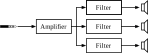
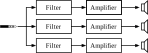
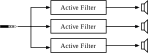
After proposing mechanisms that can be used to create filters and amplifiers in the previous section, the question remains how these circuits should be connected. Figure 3 shows 3 options. More options exist, but these are either unnecessarily complex or variations of these options. How do the following options compare?
(a)Option A
(b)Option B
(c)Option C
Figure 3:Ways to combine filter and amplification mechanisms. Filters are passive unless explicitly called active.
Options A and B differ in whether the signal should first be amplified, then filtered, or the other way around. Note that the impedance of the source is unknown and that it differs between signal sources. Connecting an impedance directly to a passive filter makes the filter behavior depend on said impedance. If the impedance is unknown, the behavior of the filter is also unknown, and one cannot guarantee that the audio system satisfies Objective 2. Amplifiers, however, can be made to have an input impedance that is so high that the source impedance becomes negligible. The output signal of the amplifier is then effectively independent of the source impedance. This leaves options A and C.
Options A and C differ in whether the filters should be passive, i.e. separated from the amplifier circuit, or active, i.e. integrated with the amplifier circuit. This choice is less straightforward. Option C is slightly more costly and complex than option A, but gives more control over how power is distributed between the different speakers and signal frequencies. This may be nice for the bass frequencies, which need more power to be audible than other frequencies. For didactical reasons, option A is chosen for the IP-1 project. However, students are encouraged to design an active filter to drive the woofers after they get option A working.
Lastly, note that the amplifier in option A needs an external power supply to increase the signal power. The opamp inside the amplifier will need a positive and a negative supply voltage. Directly connecting its supply terminals to the 230 V grid will not suffice since the grid voltage changes polarity over time, and may be too large for the opamp to handle. To solve this problem, we can use a circuit that converts the AC grid voltage to a lower DC voltage. A circuit that converts a source voltage or current to a voltage or current that is appropriate for a load is typically called a power supply.
The Project Assignment
The Base System
The design choices made in the previous section result in the circuit shown in Figure 4. You and your group are required to use this circuit, design each circuit block in more detail, and build and test them until the system satisfies the objectives listed in the objectives section.
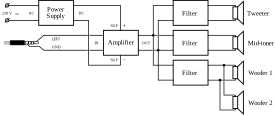
Figure 4:High level circuit diagram of the audio system including the speakers.
You must divide your project group into 5 subgroups that each work on a different block:
the power supply,
the power amplifier,
the impedance compensation and filter of the woofers,
the impedance compensation and filter of the midtoner,
the impedance compensation and filter of the tweeter.
The chapters under Course Modules in the sidebar on the left will guide you through the detailed design of each circuit block. There is one chapter for the Power Supply and the Power Amplifier. Groups that work on the filters need to go through the followng two chapters in order: Speaker Impedance and Filters.
The Booming Bass
The complete circuit will likely not have a flat transfer for the lower frequencies - the transfer will be reduced for frequencies nearing the 20 Hz lower audible range. This low frequency roll-off will make the audio sound thinner and not fully natural. To achieve a flatter overall transfer, groups with remaining time are strongly encouraged to design an active circuit to boost the lower frequencies. In this optional part of the project, you have full creative freedom—limited only by time and budget—to apply your new knowledge and skills to improve the design and possibly to design and build an add-on circuit from scratch.
The booming bass extension is typically worked on by one or more subgroups of interested students that have finished the main task. If you want, you can even boost the bass a bit more to create that pronounced booming bass effect that’s popular in many styles of music.