4. Speaker Impedance
Introduction
The objective of this module and Module 5 is to create a circuit at the input of each speaker such that the speaker input voltage is a filtered copy of the amplifier output voltage. Figure 1 shows the context of the design problem at hand.
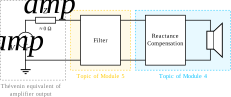
Figure 1:Problem context of Module 4 and 5. The output impedance of the amplifier is negligible, as is be explained in Module 3.
Designing a circuit that allows certain signal frequencies and suppresses others, i.e. a filter, is significantly easier when the behavior of its load does not depend on frequency. That of the loudspeakers, however, does. To compensate for this, in this module you will first model the electrical behavior of each speaker. Then, you will use this model to add a circuit at the speaker input that does not affect the speaker behavior but makes it look frequency independent, i.e. resistive, to the filter. The filters themselves will be designed in Module 5.
Load Impedance Characterization
Lab preparation
This section is divided into a theory part and an instruction part. Please go through the theory before coming to the lab to save precious lab time.
Brief reminder of the concept of impedance
Impedance is the generalization of resistance to AC circuits. It relates voltage and current in the frequency domain: . Unlike resistance, impedance is a complex quantity, having magnitude and phase, that accounts for both energy storage and dissipation. It determines how a component opposes current at different frequencies. The following table gives the impedance of a few common circuit elements. Note that .
Table 1:Impedance of ideal resistors, capacitors and inductors.
Element | Impedance [Ω] | Description |
|---|---|---|
Resistor | Purely real (no imaginary part), so voltage and current are in phase. Frequency‑independent. | |
Capacitor | Purely imaginary (current leads voltage by 90°). Magnitude decreases with frequency — capacitors behave like a short at high frequencies and an open at low frequencies. | |
Inductor | Purely imaginary (voltage leads current by 90°). Magnitude increases with frequency — inductors behave like an open at high frequencies and a short at low frequencies. |
Theory: Loudspeaker Modeling
A model of the frequency dependent behavior of the speakers is necessary to:
understand how to create a circuit to compensate for this behavior,
simulate whether the compensation circuit is effective.
The IP-1 speaker box contains so-called dynamic loudspeakers. This section first explains how these work, and then presents an electrical model based on this understanding.
The physical operating principle of dynamic loudspeakers is shown in Figure 2. Permanent magnets create a static magnetic field. A cylindrical piece called a former is placed in this field with a coil wrapped around it called the voice coil. When current flows through the voice coil in this static field, it creates a Lorentz force on the coil. This force pushes and pulls the former along the x-axis.
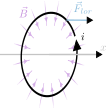
Figure 2:Lorentz force generated on a current loop in the presence of a static magnetic field perpendicular to the path of the current.
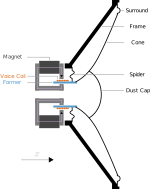
Figure 3:Simplified schematic drawing of the sideview cross-section of a dynamic loudspeaker.
Figure 3 shows how the former is connected to a diaphragm called the cone. When the former pushes and pulls the cone it moves air, which causes local pressure changes that propagate away from the speaker as sound waves. The cone is connected to the speaker frame by the surround and the spider, which act as springs. Finally, the center is sealed off by a dust cap to protect the sensitive electronics.
The former, cone and air form a mass that is suspended by the spider and the surround which act as a spring. This mass-spring system is typically modeled as a 2nd order ODE which, like a 2nd order linear circuit, can resonate. The voice coil in the static field not only turns current into movement, but also turns movement into a counteracting electromotive force (EMF). This follows from a physics law, called Faraday’s law. This EMF is the strongest when the mass-spring system resonates.
What is an ODE?
An ordinary differential equation (ODE) relates a function and its time derivatives. ODEs describe how a physical quantity evolves in time given forces or inputs. This term will be introduced more formally in EE1C2 with examples and solution techniques.
The speaker is therefore a combined electrical-mechanical system. When measuring its electrical properties, it is found that they are also influenced by the mechanical properties. This is clearly visible in a plot of the magnitude of the impedance that is measured between the two input connections of the loudspeaker, as seen in Figure 4. The dashed curve in this figure presents the measured impedance vs frequency of a midtoner speaker. It turns out that the resonance of the speaker is visible in the peak of the impedance curve around 100 Hz.
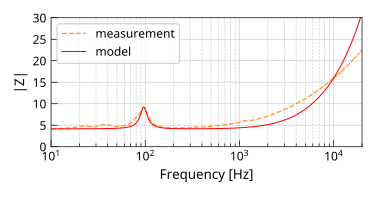
Figure 4:Measured and modeled (see below) midtoner speaker impedance as a function of frequency.
The speaker impedance can be modeled as an electrical circuit where components represent both the voice coil and the mechanical mass–spring system. Figure 5 shows the impedance model. Together, these components represent the impedance that is measurable at the speaker’s input. We call this Model 1.
represents the DC resistance of the voice coil.
represents the self-inductance of the voice coil.
, , and represent the electrical equivalent of the mass–spring system.
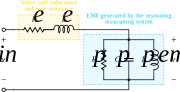
Figure 5:Impedance model of a dynamic loudspeaker (Model 1).
What is modelling?
Modelling is the process of representing a real system using a simplified version that captures its essential behaviour. In electrical engineering, this often means describing physical or mechanical systems using equivalent electrical circuits or mathematical relationships. For example, a loudspeaker can be modelled as an electrical circuit, where resistors, capacitors, and inductors represent both its electrical properties and its mechanical motion. A good model helps us understand, predict, and improve how a system performs without needing to test every possible real-world situation.
With properly fitted parameters, the model in Figure 5 produces the impedance curve shown as a solid line in Figure 4. The fit is imperfect because the model simplifies the real physical system. The activities after this theory section explain how to derive the model parameters from impedance measurements.
Now, with , and depending on the mechanical properties, the mechanical properties will change when the speaker is mounted in a closed cabinet. This is because the air trapped inside the cabinet increases both the effective moving mass and the spring stiffness. The changed mechanical system results in different values for the components of the equivalent circuit model for the speaker. All measurements for this project are made with the speaker mounted in the same type of closed cabinet you will be using, so the parameters you determine already include these effects.
Application
The impedance data of the speaker box can be downloaded from Brightspace. When you plot the magnitude of the impedance as a function of frequency in Python, it should look roughly like Figure 4. Notice the peak on the left, and the rise on the right.
To derive the values of the circuit elements from the model in Figure 5 from this data, it is convenient to look at the effects of the voice coil ( and ) and the effects of the mechanical resonance (, , and ) separately. The combined impedance can be written as:
Figure 6 and 7 show the impedance of the voice coil and the mechanical resonance in isolation respectively. In circuit terms, Figure 6 shows the impedance of a resistor in series with an inductor, and Figure 7 shows the impedance of a parallel RLC circuit.
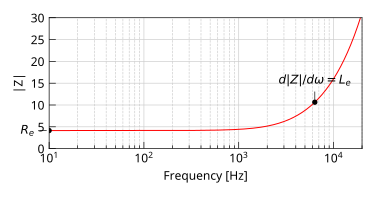
Figure 6:Impedance magnitude of voice coil effects in isolation.

Figure 7:Impedance magnitude of mechanical resonance effects in isolation.
The value of can be determined from the fact that . This is because at DC the inductors and become short circuits. can be determined from the slope of the rising tail on the right.
The properties of parallel RLC resonators can be used to determine the values of , and . At some frequency the current through is equal in magnitude but opposite in phase to the current throguh . Hence, at the parallel combination of and can be replaced by an open circuit, reducing the circuit to simply . In other words:
The value of can be determined by setting the admittance of in parallel with to zero.
The width of the resonance peak in Figure 7 yields another equation.
Here, and are the frequencies for which of the parallel RLC circuit equals . The derivation of this property of parallel RLC circuits is found in your EE1C2 textbook.
Use these equations to derive the values of each circuit element from the data that is given to you on Brightspace. You must simulate the circuit with your derived values in LTspice and compare it with the measurement data to determine the accuracy of your model.
Load Reactance Compensation
Lab preparation
This section is divided into a theory part and an instruction part. Please go through the theory before coming to the lab to save precious lab time.
Theory: Zobel Networks
Filter design becomes significantly easier when the load impedance does not depend on frequency, i.e. if the load is purely resistive. The speaker impedance can be modified to become resistive by adding linear components possibly in series and/or in parallel.
To ensure that the output voltage of the filter equals the speaker input voltage, the option of inserting something in series with the speaker becomes undesired. The question then becomes: Is it possible to insert an impedance in parallel to the load such that the equivalent impedance has no imaginary part? This scenario is depicted in Figure 8.
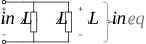
Figure 8:An impedance in parallel with such that .
Setting the parallel combination of and equal to some arbitrary resistance yields:
This equation simplifies beautifully when , that is, if it can be split into a resistive part and a remainder . In this case becomes:
The circuit from Figure 8 then turns into Figure 9 below. Circuits like this are typically called Zobel networks or constant resistance networks.
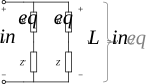
Figure 9:If , then .
Application
From Figure 5 we can write the expression for the loudspeaker impedance according to the impedance model as:
Note that speakers should not be operated at or below their resonance frequency . At these frequencies, several problems arise. Most notably, the sound pressure level drops off rapidly (at 12 dB/octave below resonance) making sound reproduction at these frequencies inefficient and inaccurate. Additionally, the amplifier loses control over the cone’s motion, leading to distortion and potential mechanical damage from excessive excursion. By operating above , Equation (7) can be simplified to Equation (8). We call this Model 2. It is just a resistor and an inductor in series.
This restriction also explains why bass drivers must be large. Larger drivers with greater moving mass have lower resonance frequencies, allowing them to reproduce low frequencies in their usable range above .
Create a Zobel network where , to compensate for the frequency dependent behavior introduced by . Note that this is of course not necessary if the effect of on within the frequency range of operation is negligible.